
DS-RAG
Decentralized RAG for data sovereignty.
- Feb 2026
- IEEE publication
The problem
Small Island Developing States face a bad trade: use frontier LLMs and surrender sensitive national data to foreign infrastructure, or keep data sovereign and lose access to state-of-the-art AI. For healthcare records, census data, and government documents, that trade-off is often a hard blocker on adoption.
DS-RAG — published at IEEE, February 2026 — proposes a third option: a decentralized retrieval-augmented generation protocol where sensitive corpora stay in-country while global models remain usable.
The architecture
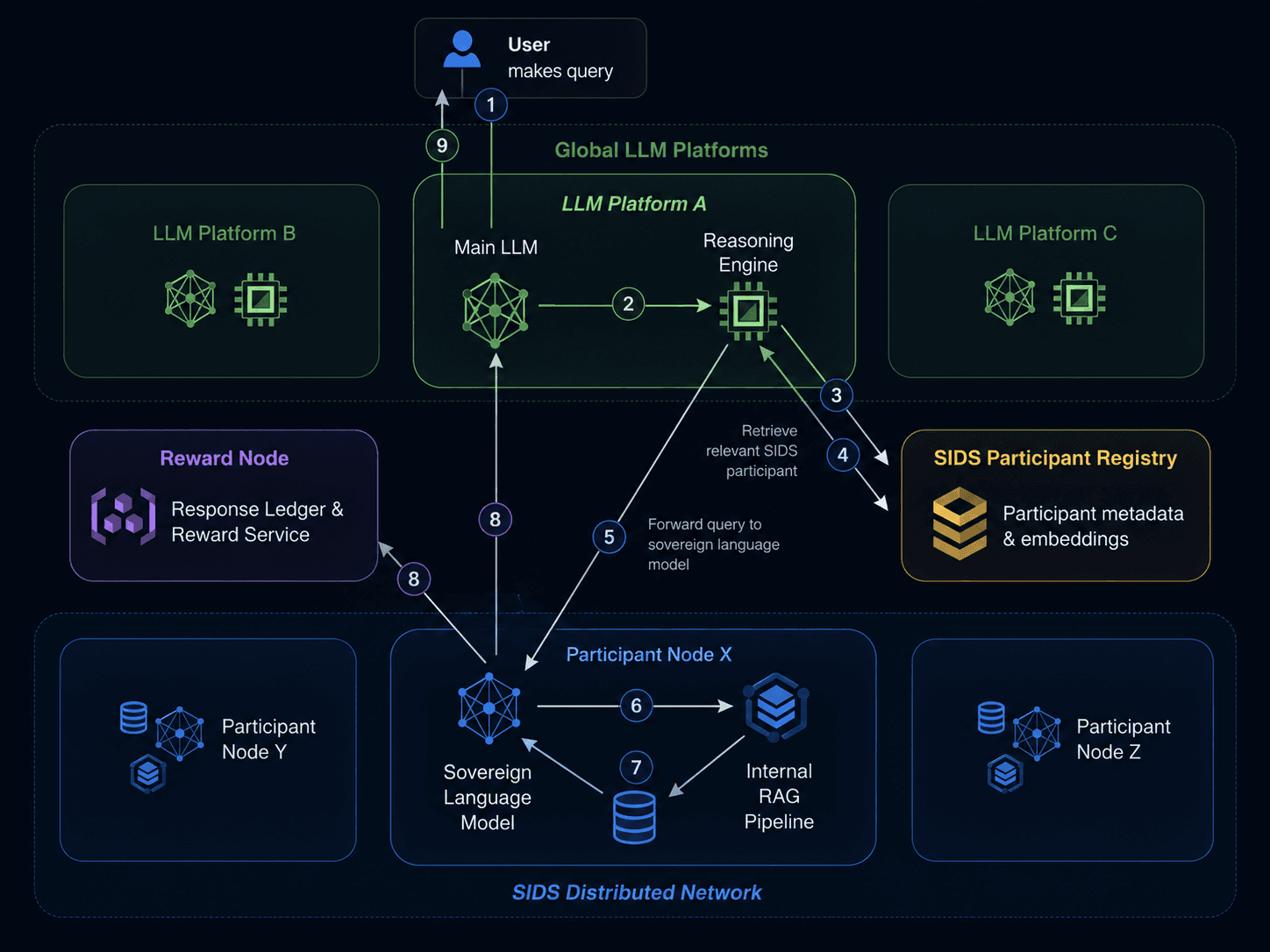
The core idea is a hierarchical split between where knowledge lives and where reasoning happens:
- Local retrieval layer — sensitive documents are embedded and indexed inside national infrastructure; raw data never crosses the border.
- Global reasoning layer — frontier LLMs receive only the minimal retrieved context needed to answer, not the corpus itself.
- Protocol layer — defines how queries route between local nodes and global models while preserving sovereignty guarantees.
Why it matters
Data sovereignty frameworks usually arrive as policy documents; DS-RAG is an engineering answer. It gives small nations a concrete architecture for adopting LLMs without ceding control of their data — relevant to healthcare, education, and government services across the Caribbean and beyond.
Read more
Published as Global Hierarchical LLM Framework for Precise Responses — Anthony Jairam, Tamika Ramkissoon, Kevin Baboolal, Prof. Patrick Hosein. IEEE, February 2026.